
Criminal Cases in the Hampshire County Courts
Hampshire County criminal cases divide among three local courts. The Hampshire County Magistrate Court handles misdemeanors, felony complaints and preliminary examinations, initial appearances, bail, and arrest or search warrants. A felony that moves past the lower-court stage proceeds to the Hampshire County Circuit Court in West Virginia's Twenty-Sixth Judicial Circuit. Circuit Court is the general-jurisdiction trial court. It hears felonies, certain misdemeanors, and appeals from magistrate and municipal courts. Romney Municipal Court remains separate for city ordinances, municipal citations, and related bench matters.
The clerk for each court holds its own file. Circuit Clerk Sonja Embrey is the custodian for felony pleadings, orders, older records, and documents absent from WVPASS. Magistrate Clerk Christie D. Davis confirms lower-court results and provides available copies because the public Magistrate search does not download source documents. A municipal citation may never become a county case. Start with the court named on the citation or docket, and save each case number when a felony complaint later receives a Circuit number.
The official Circuit Court directory shows the clerk and judge contacts for Hampshire County. The published page also supplies a visual view of the court contact block.
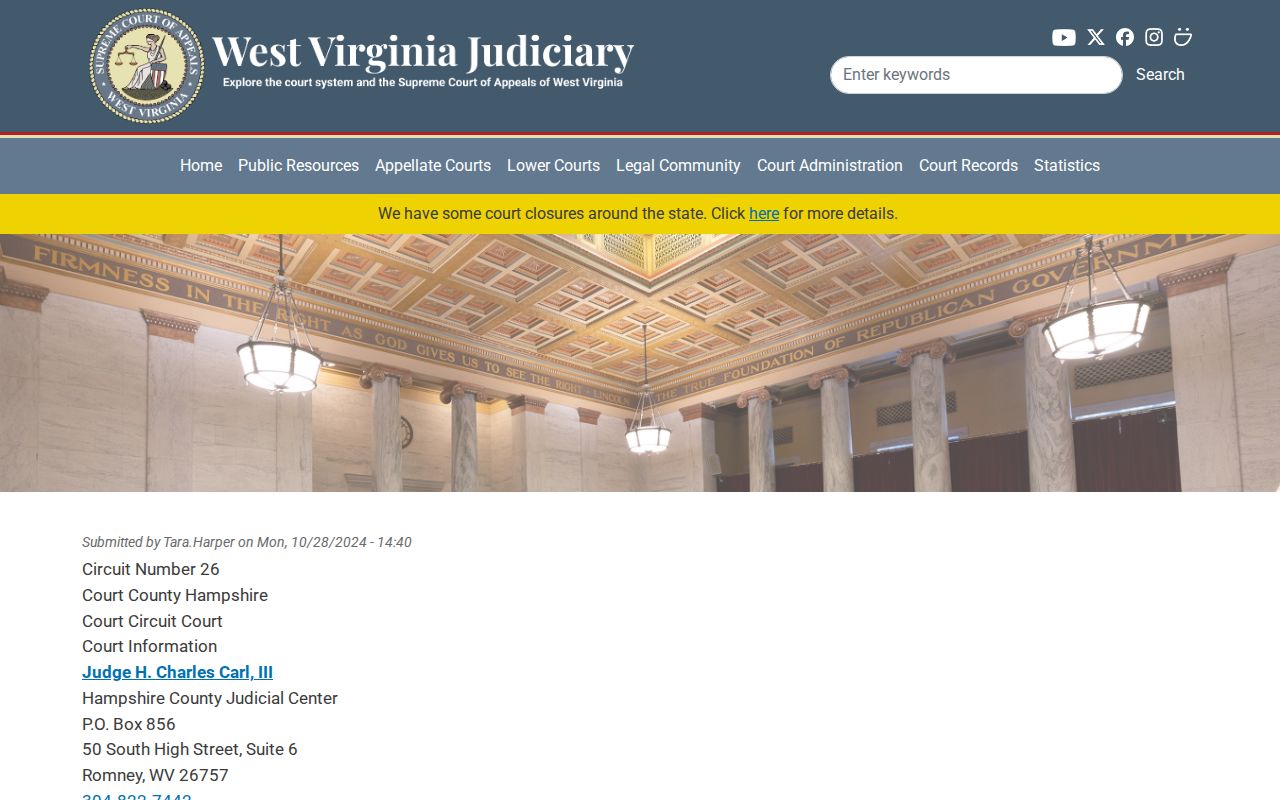
That directory is the fallback when an online Hampshire County criminal case search omits an older file or a document needed to read the outcome.
Hampshire Criminal Court Levels
The court label is more than an address. It tells the reader what stage the record reflects. A Magistrate entry called “Felony Complaint” shows an accusation at the opening stage. It does not prove that Circuit Court entered a felony judgment. “Warrant Issued,” “Bond/Bail Set,” and “Initial Appearance: Rights Sheet” are procedural events. A final order or disposition must be read separately.
West Virginia also does not use a universal Class A, B, or C felony ladder. Under W. Va. Code §61-11-1, a felony is an offense punishable by confinement in a state correctional institution. Other offenses are misdemeanors, and the statute for each offense supplies its term and fine. In Hampshire County, Circuit Court is the felony court while Magistrate Court normally resolves misdemeanors and handles the early part of a felony case. Romney Municipal Court covers proper city matters, not the full county docket.
| Court | Typical criminal work | Official record route |
|---|---|---|
| Magistrate Court | Misdemeanors, complaints, warrants, bail, preliminary felony events | Magistrate Case Record Search or clerk |
| Circuit Court | Felony prosecution, certain misdemeanors, appeals, judgments | WVPASS or Circuit Clerk |
| Romney Municipal Court | City ordinance and municipal citation matters | Municipal Court at 304-822-4060 |
How to Search Case Records
Use the official West Virginia court-record access page to choose the proper system. Magistrate Search is free and requires no account. WVPASS requires free registration and covers publicly available Circuit documents statewide back to 1999. WVPASS searches are free, while downloads cost $0.25 per page plus a nominal card-processing fee. Neither route makes the clerk optional when a record is old, sealed, restricted, unindexed, or missing online.
- Decide whether the matter began in Magistrate, Circuit, or Romney Municipal Court. Use Magistrate Search for a misdemeanor or early felony record.
- Enter a first name, last name, or case number. A case number is the strongest key, while a broad name can reach the 30-result cap.
- Accept the disclaimer, run the search, and compare the filing date, court level, charge, and birthdate where shown.
- Read docket entries in sequence. Do not treat a motion as the court's order or a bond event as a finding of guilt.
- Ask the filing clerk for the source document, certified copy, older file, or a result that cannot be verified online.
| Field Label | Type | Required | Options or notes |
|---|---|---|---|
| First Name | Text | One search key needed | May be used by itself |
| Last Name | Text | One search key needed | Broad names may reach 30 results |
| Case Number | Text | One search key needed | Best identifier when known |
| Disclaimer acceptance | Checkbox | Yes | Click to continue before Submit |
| Submit | Button | Yes | Runs the search |
Note: Magistrate Search shows at most 30 matches and no downloadable pleadings, so the filing clerk remains the source for confirmation and copies.
Inside Hampshire Magistrate Search
A Hampshire Magistrate detail can show the case event schedule, parties and roles, and a docket list. Event data may include the type, date, room, location, judge, and reason an event closed. Party roles can include the defendant, officer, prosecutor, surety, magistrate, and defense attorney. The result can also display a birthdate. Use that field only to distinguish records, and avoid spreading personal data that is not needed.
Docket labels require care. “Motion Filed for Dismissal” means someone asked the court to dismiss. The result needs a later order or disposition before that request can be treated as granted. “Order: Criminal Judgment” points toward an outcome, but the actual order gives the terms. Bond encumbrance, waiver of preliminary-hearing time, counsel notices, and a rights sheet all describe steps, not guilt. The Judiciary's Magistrate Search explanation also warns that the index is not a complete civil or criminal history.
The official Magistrate Case Record Search displays the entry form used for Hampshire County case records.
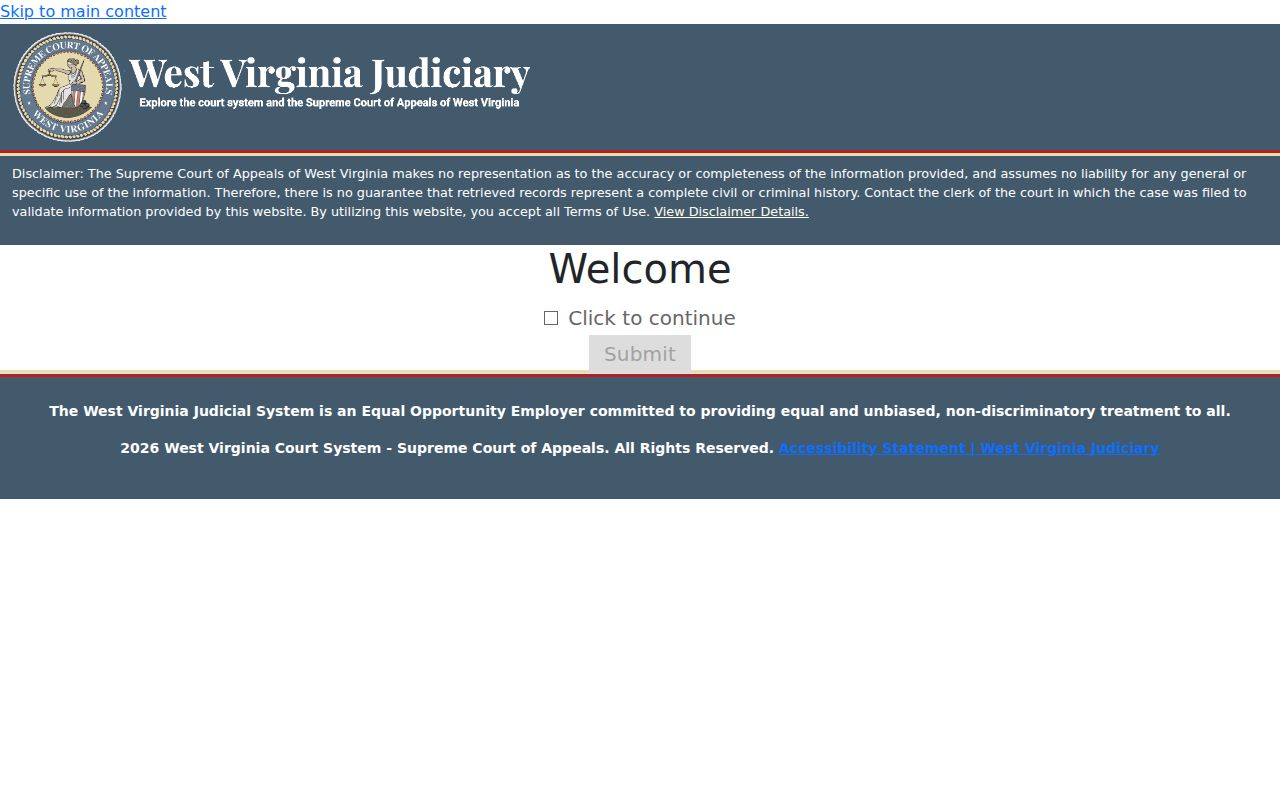
The form's few search keys make exact spelling and a known case number especially useful when a common name would produce too many matches.
What the Case File Shows
A court file connects the accusation to what the judge finally ordered. The docket is an index of activity, while pleadings and orders hold the detail. In Hampshire County criminal court cases, the useful file may include the complaint or indictment, attorney appearances, motions, hearing notices, bond actions, pleas, trial events, judgment, sentence, and an appeal trail. WVPASS may let a reader download public Circuit documents. Magistrate Search lists documents but does not provide the files themselves.
| Case Number & Court | Identifies the filing court and the number needed for a precise clerk request. |
|---|---|
| Charging Document | States the filed allegation, such as a complaint, information, or indictment. |
| Docket Entries | Chronological index of filings, service, bond actions, motions, hearings, and orders. |
| Hearing Dates | Shows scheduled events, judicial officer, location, and whether an event closed. |
| Disposition & Judgment | Records how each charge ended and the court's final ruling. |
| Sentence & Conditions | States custody, probation, financial terms, or other court-ordered conditions when public. |
Read the judgment with any later order. Appeals, corrections, and expungement can change access or legal effect after the first disposition appears. A certified copy from the clerk is the sound choice when the exact wording matters.
Hampshire Criminal Case Bond Terms
Bond entries show how release was handled while a Hampshire County criminal case was pending. They do not decide guilt. The Magistrate detail may list bail as set, posted, released, or encumbered. An encumbrance records that the bond is tied up or subject to a claim or court action. A release entry concerns the bond obligation, not necessarily the end of the charge.
Read each term beside its filing date and the later disposition. A service entry can prove that process was completed, while a closed hearing event says only that the scheduled event ended. The final judgment or dismissal order remains the outcome source.
- Bond/Bail Set
- The court fixed release terms or an amount while the charge remained pending.
- Bond/Bail Posted
- The docket reports that the required bond step was completed.
- Bond Encumbrance
- The bond became subject to a recorded claim, hold, or court action.
- Bond Released
- The bond obligation was released; this entry alone does not state the case disposition.
Hampshire Criminal Case Clerk Fallback
The Hampshire County Judicial Center at 50 South High Street in Romney places Circuit Court and Magistrate Court in one building. Circuit Clerk Sonja Embrey is in Suite 157 and can be reached at 304-822-5022. Magistrate Clerk Christie D. Davis is in Suite 3 at 304-822-4311. Judiciary directory pages do not publish office hours, so call before traveling. Bring the correct name, case number if available, and an approximate filing date.
Clerk staff retrieve a specific file for supervised inspection. The public does not enter storage areas. That process matters for pre-1999 Circuit records, archived papers, and documents not available through WVPASS. Public terminals at clerk offices can search Magistrate records statewide. Online absence still may reflect an old case, a restriction, an archive location, indexing limits, or a document that requires staff retrieval.
The official Hampshire Magistrate Court directory gives the clerk and magistrate contact details.
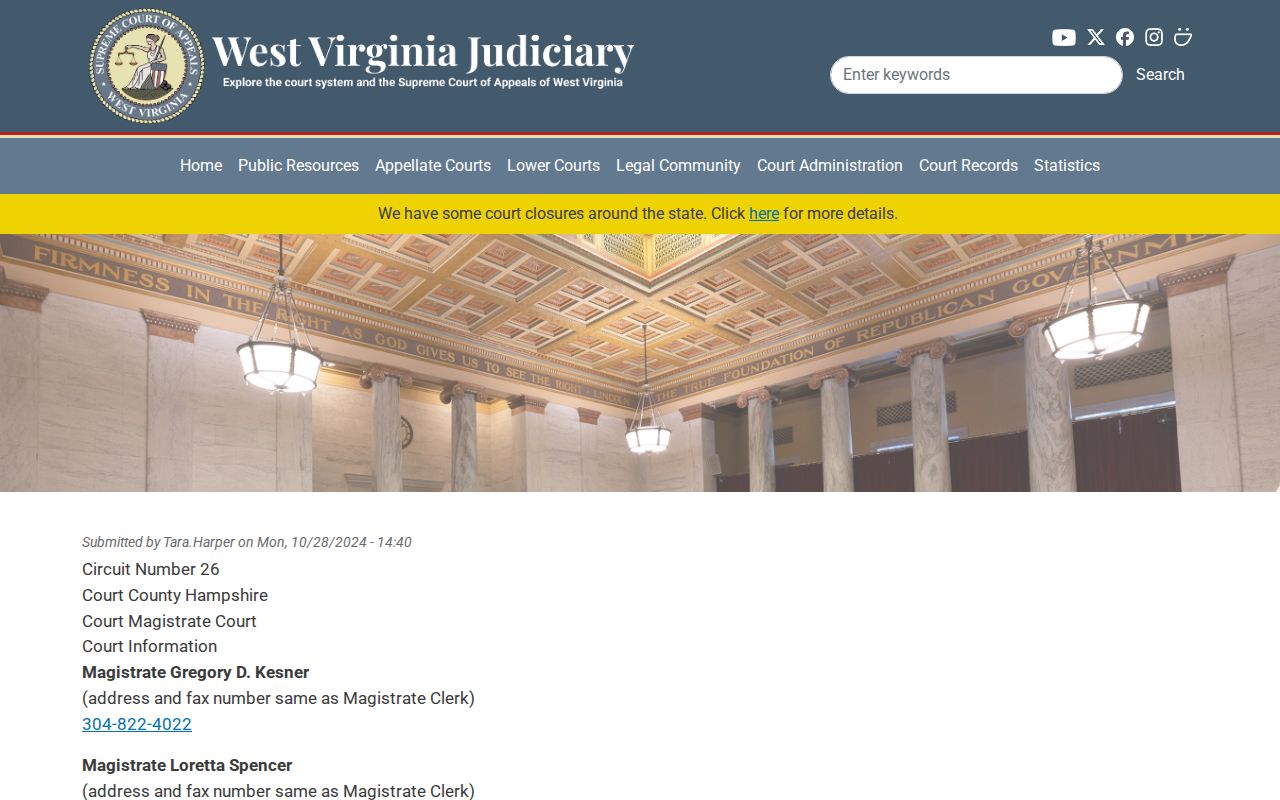
This contact route closes the gap between a short public index entry and the actual lower-court paper needed to confirm a case event.
Stages of a Criminal Case
A Hampshire County criminal case can start in Magistrate Court even when the alleged offense is a felony. The complaint, initial appearance, rights sheet, bail, and preliminary hearing form the lower-court trail. A felony that proceeds then reaches Circuit Court through an indictment or other proper charging paper. Misdemeanor matters may remain in Magistrate Court. Municipal cases follow Romney's separate court route unless an appeal or different county charge moves the matter elsewhere.
Case flow: Charges Filed → Arraignment → Pretrial → Plea or Trial → Disposition → Sentencing
Each step can create a docket entry, but not every entry resolves the charge. Arraignment states the charge and plea. Pretrial work includes discovery, motions, scheduling, and plea talks. A plea or trial leads to disposition. Sentencing states the penalty and terms. A later appeal or order may add another layer. For the arrest and custody records that precede this flow, use the county's arrest history routes and then return to the judgment for the legal outcome.
Hampshire Court Records Since 1999
WVPASS launched for registered public users on March 10, 2025. It offers publicly available Circuit Court documents from all West Virginia counties back to 1999. Hampshire had used CourtPLUS e-filing since November 1, 2015, and CourtPLUS became available statewide in 2024. These systems serve different users. WVPASS is the public search and download route. CourtPLUS is a filing and case-management system, not the public door for a Hampshire County criminal case lookup.
The date line explains why a modern Circuit case may have online documents while an older file requires a call. It does not make WVPASS a complete criminal-history database. Magistrate records remain in their own search, municipal matters remain with Romney, and restricted files stay outside normal public display. CourtOne integration work is modernization in progress, not a current replacement for the separate search channels.
Access & Restrictions
Public access has limits. Sealed or expunged cases, juvenile records, victim information, medical data, domestic and mental-health matters, and protected identifiers may be withheld or redacted under governing law and court rules. Social Security numbers, driver's-license data, financial account numbers, and similar private identifiers should not appear in a public view. A redacted online copy may therefore differ from the full court file.
West Virginia FOIA governs many executive-agency records, but court access is administered through judicial rules and clerk procedure. The FOIA request statute should not be treated as a way around a court restriction. Ask the clerk whether a particular case is public, archived, sealed, or available only in part. If an online result is unclear, request the specific docket paper or order rather than a broad demand for every record.
An eligible person may petition for expungement under §61-11-25 for certain acquittals, dismissals, diversion outcomes, and deferred-adjudication dismissals, or under §61-11-26 for some convictions. Eligibility, exclusions, waiting periods, and service rules vary. The Circuit Clerk is the Hampshire filing point, and no one should infer the effect of an expungement without checking the signed order and agency completion.