
Running a Sex Offender Check in Hampshire County
The West Virginia Sex Offender Registry is the main official channel for a Hampshire County registry check. It is free, needs no account, and asks each visitor to accept its disclaimer before searching. Start with the county filter when the goal is a broad look across Hampshire County. A known last name, street, or city can narrow the results. The portal says it updates daily, yet that update schedule does not guarantee that every recent move or other reportable change has reached the system and passed verification.
Prepare only the details that fit the question. County mode works well for a countywide view. Basic street mode searches a street name, while Neighborhood Search measures a chosen radius around an address. Those are not the same tool. Email Search checks an email address or username in registry data. Advanced Search adds filters for wanted offenders and sexually violent predators. For an error or stale entry, contact the WVSP Registry at 304-746-2133 or registry@wvsp.gov rather than drawing a conclusion from the screen alone.
Note: A public registry result is a safety record, not a complete Hampshire County criminal history or a finding about present risk.
Hampshire County Registry Search Modes
The quickest broad query uses Basic Search. Choose “County” under Search By, then select “HAMPSHIRE” under County Name. Selecting “ALL COUNTIES” expands the query statewide. “OUT OF STATE” may help with records marked that way, but it cannot replace a national check. The Last Name, Street Name, and City options each search only the field stated. A sparse result may reflect spelling, an alias, geography, or reporting time, so changing the mode can be more useful than repeating the same query.
Advanced Search lets a user combine a last name, street, city, and county. Its “Wanted Offenders Only” and “Sexually Violent Predators Only” choices are separate filters. Neither means the same thing as the other. For the widest advanced result set, leave “Do not limit my search” selected. This distinction matters because West Virginia does not publish a general Tier I, II, and III risk scheme. The form’s labels describe search filters and statutory status, not a broad prediction of danger.
Searching the West Virginia Sex Offender Registry
Use the search mode that matches the place or identifier being checked. The county setting is often best for Hampshire County because postal city names and municipal borders do not always line up with rural county boundaries. The full sequence is short:
- Open the official registry and read and accept the conditions of use.
- Choose Basic, Advanced, Email, or Neighborhood Search based on the facts available.
- For a countywide query, set Search By to County and County Name to HAMPSHIRE.
- Review the matching profile, including the qualifying offense and registration status, then report apparent errors to WVSP.
The official form exposes the following basic and advanced controls. A broad search can produce more names than a precise one, but a narrow query can miss a record when the input does not match the registered data.
| Field Label | Type | Required | Options or Format |
|---|---|---|---|
| Basic: Search By | Dropdown | Yes | Last Name, Street Name, City, or County |
| Basic: Search Text | Text | Except County mode | Maximum 200 characters |
| Basic: County Name | Dropdown | In County mode | HAMPSHIRE, all 55 counties, or out of state |
| Basic: Search | Button | Runs query | Uses the selected basic mode |
| Advanced: Last Name | Text | No | Maximum 100 characters |
| Advanced: Street Name | Text | No | Maximum 100 characters |
| Advanced: City | Text | No | Maximum 100 characters |
| Advanced: County | Dropdown | No | All counties, any West Virginia county, or out of state |
| Advanced: Limit Results | Radio | No | Wanted only, sexually violent predators only, or no limit by default |
| Advanced Search | Button | Runs query | Uses the advanced fields and chosen filter |
| Email or Username | Text | Yes | Minimum 1 and maximum 255 characters |
| Email Search | Button | Runs query | Checks the entered email address or username |
| Neighborhood: Street Address | Text | Location input | Street address for the center point |
| Neighborhood: City | Text | Location input | Neighborhood city |
| Neighborhood: ZIP | Text | Location input | Maximum 5 characters |
| Neighborhood: Radius | Dropdown | Yes | 1, 3, 5, 10, 15, or 25 miles |
| Neighborhood: County | Dropdown | Location input | All counties, any West Virginia county, or out of state |
| Neighborhood Search | Button | Runs query | Uses the entered location and required radius |
The official WVSP registry screen shows both the search controls and its caution about the data.
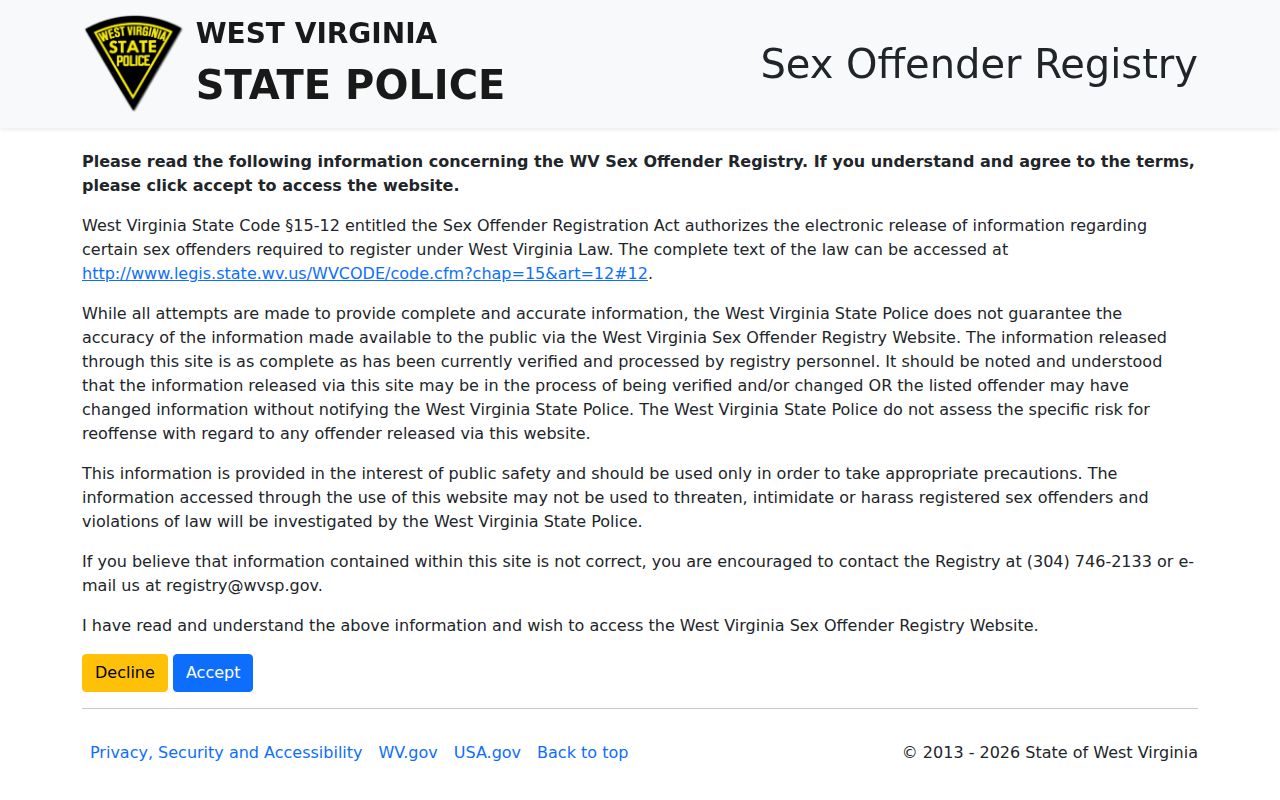
The image reinforces why readers should accept the conditions, select the right mode, and treat each returned profile as official registry data with stated limits.
Hampshire Registry Radius and Email Checks
Neighborhood Search accepts a street address, city, ZIP code, and county, then requires a radius of 1, 3, 5, 10, 15, or 25 miles. It is a proximity tool. Basic Street Search only looks for the entered street name. The radius option can be more useful in a rural part of Hampshire County where a nearby residence may fall outside a town line or use a different postal city. Start small for close surroundings, then widen the distance only when the safety question calls for it.
Email Search takes an email address or username. A match can connect that identifier to the public registry data supplied under Article 12. No match has a much narrower meaning: the exact input did not produce a result from the registry data available at that time. It is not a universal check of online identity, and it should never be portrayed as one. Suspected misuse of an identity or suspected failure to report belongs with law enforcement.
What a Registry Profile Shows
West Virginia law requires a broad registration record, while W. Va. Code §15-12-5 controls what the public may see. The record can include names and aliases, residences, school or training, business or employer information, internet identities, vehicles, qualifying offense facts, release or supervision information, fingerprints, and a photograph. Public disclosure has limits. Victim names and protected contact details must not be republished.
| Name and Aliases | Full name plus registered aliases, nicknames, and other identities that the public display permits. |
|---|---|
| Photo and Description | A registry photograph and identifying physical description used to help distinguish records. |
| Registered Residences | Address or residence information made public under the disclosure statute. |
| Work, School, and Vehicles | Registered business, school or training, and vehicle, aircraft, or watercraft information when publicly releasable. |
| Offense and Court | The qualifying offense, court, date, and related statutory registration basis. |
| Release and Supervision | Release, probation, or parole facts tied to when registration duties begin. |
| Electronic Identities | Internet accounts, usernames, or other electronic identities within the public disclosure rules. |
| Registration Status | Current registry status and public notices, subject to reporting and verification lag. |
Read the offense and court fields with care. A registry profile is purpose-built for public safety and does not list every criminal case. WVSP also says it does not assess a listed person’s specific chance of reoffending. For an outcome or judgment, the court file remains the better source.
Hampshire Registry Checks Across Borders
Hampshire County sits near state lines, so a county-only query may not answer a cross-border question. The U.S. Department of Justice operates the National Sex Offender Public Website, which searches participating jurisdictions through one national layer. Use it when a route, family activity, or other safety concern extends toward Virginia, Maryland, or another state. Then open the source jurisdiction’s official result for its own terms and current detail.
The national registry source illustrates the federal cross-state search layer assigned to this Hampshire County check.
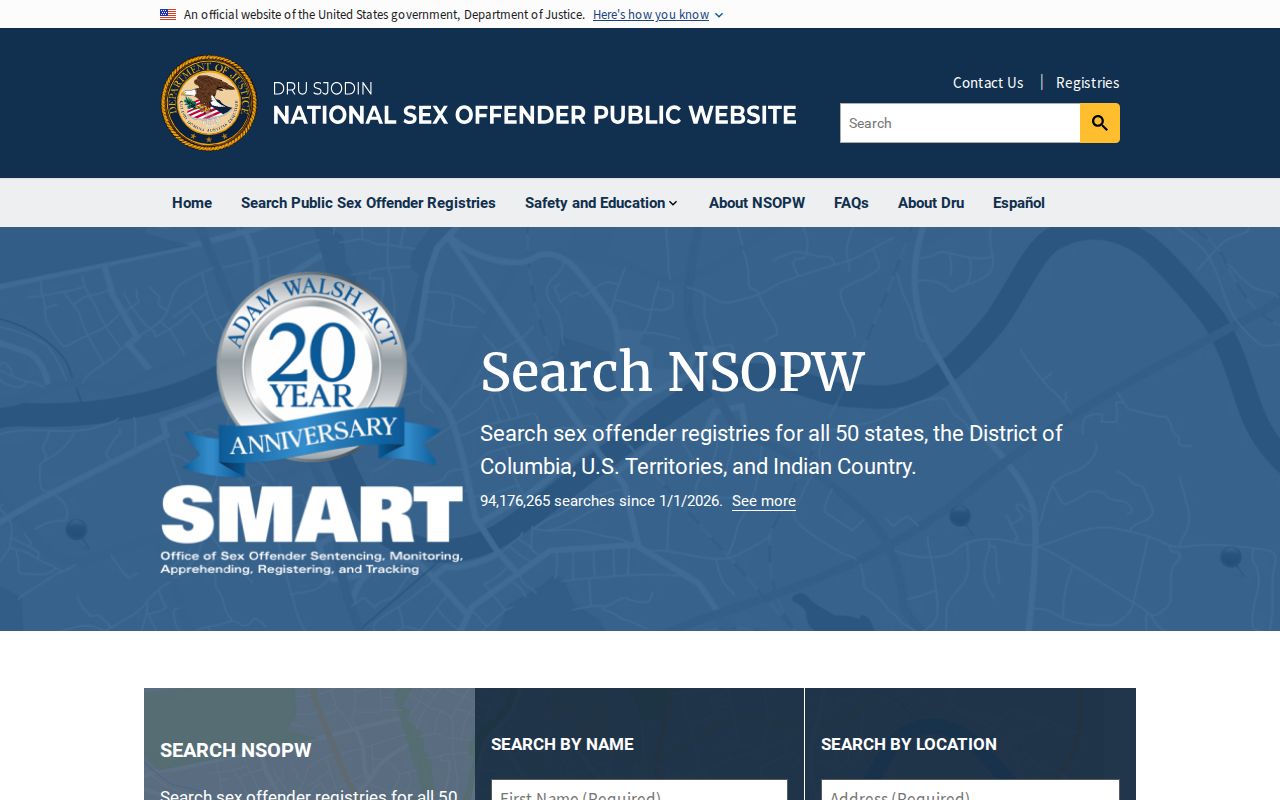
That national reach adds geographic coverage, but WVSP remains the contact for correcting a West Virginia entry. Call 911 for an emergency. Send concerns about apparent noncompliance to law enforcement, not to the listed person or household.
Note: National results broaden the map, while the originating state registry supplies the governing profile and correction channel.
Registration Requirements and Levels in West Virginia
West Virginia’s public framework is based on ten-year registration, lifetime registration, and special duties for a sexually violent predator. Calling these public Tier I, II, and III levels would be false. Under W. Va. Code §15-12-4, duration begins from release from prison, jail, or a mental facility, or from placement on supervision. It does not simply start on the conviction date. Early discharge from supervision does not shorten a ten-year term.
| Statutory Category | Duration | Verification | Public Visibility |
|---|---|---|---|
| General qualifying registrant | Ten years from the statutory release or supervision benchmark | Reports in birth month; WVSP verifies address annually | Public fields are limited by §15-12-5 and the official registry display. |
| Prior qualifying offense, multiple-victim or multiple-violation finding, sexually violent offense or predator designation, or qualifying offense involving an actual or perceived minor | Lifetime | Statutory reporting and annual address verification apply unless the predator schedule controls | Lifetime duration does not create a separate public risk tier; §15-12-5 controls disclosure. |
| Sexually violent predator | Lifetime where the statutory basis applies | Reports in January, April, July, and October; address verification every 90 days | The official search can filter this designation; protected victim and contact data stay excluded. |
Do not calculate one person’s end date from a profile excerpt. The correct benchmark depends on the judgment, qualifying facts, release, and supervision record. The official duration statute pictured below is the source for Hampshire County registration timing.
The West Virginia Legislature’s duration provision sets the ten-year and lifetime rules.
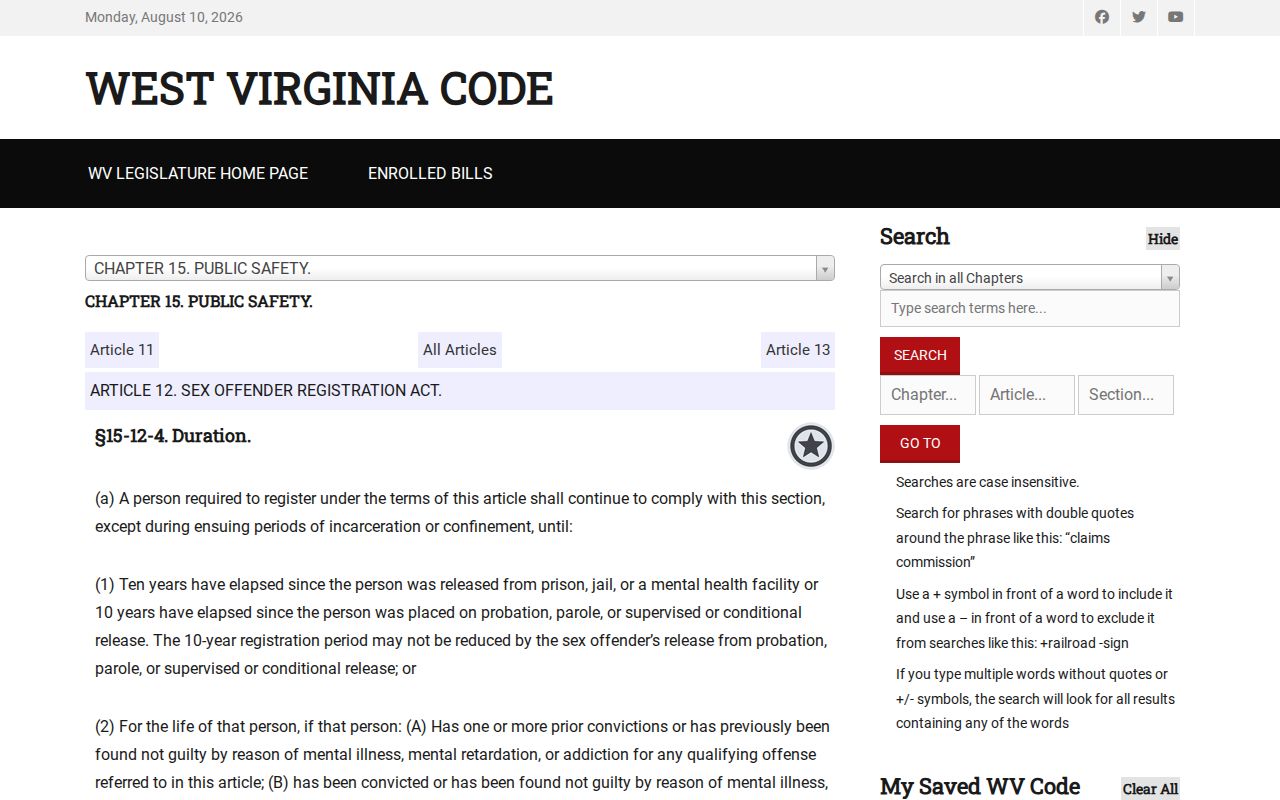
The statute confirms why an accurate check uses qualifying facts and release or supervision data rather than a made-up numeric tier.
Hampshire Registry Updates and Gaps
A daily website refresh is not the same as instant fact collection. A registrant may not yet have reported a change, submitted data may be under review, or a correction may still be moving through verification. WVSP says the data can be undergoing change and does not give an absolute accuracy guarantee. That is why an unexpected address, identity, or status should be checked with the Registry at 304-746-2133 or registry@wvsp.gov.
Use a calm correction path. Save the profile location and note the field that appears wrong. Contact WVSP with the specific concern. If a person seems to be violating a duty, report the facts to law enforcement. Do not investigate through contact, surveillance, public accusation, or pressure on a household. The registry exists for public awareness and official compliance work.
Hampshire Registry Data Is Not Risk
The registry does not provide a personalized risk score. It reports statutory and registration facts. A wanted-only filter concerns wanted status, while the sexually violent predator filter concerns a legal designation. Neither should be stretched into a claim about what someone will do. Community safety choices should rest on the actual profile, the place involved, current official guidance, and ordinary precautions.
This limit also explains why registry records and Hampshire County court files have distinct roles. Registry disclosure answers who is publicly registered and what information Article 12 permits. A criminal case file documents charges, proceedings, and disposition. For deeper case context, use the Hampshire County criminal court records route and verify the judgment with the correct clerk.
Lawful Use and Community Notification
West Virginia’s Sex Offender Registration Act describes the system as a public-safety measure rather than added punishment or retribution. Lawful use includes learning about registered locations, planning family and neighborhood precautions, and giving law enforcement specific information about an apparent reporting problem. It does not include confronting a listed person, targeting a household, or using the listing to spur threats.
Registry misuse can be a crime: The official WVSP registry warns that threatening, intimidating, or harassing a registrant is prohibited and will be investigated. W. Va. Code §15-12-1a states the system’s public-safety, non-retribution purpose. Report suspected noncompliance to law enforcement instead of acting directly.
Community notification under Article 12 is controlled by statute, including limits on victim and contact information. Use only what the official public display releases. Avoid reposting more personal detail than a safety need requires. When accuracy matters, confirm it with WVSP. When danger seems immediate, call 911.